
Quality Control for LLM-Powered Chatbot Applications
- Kostiantyn Isaienkov

- Dec 27, 2025
- 10 min read
Updated: Jan 5
Building a high-quality chatbot is not just about generating good-looking responses. In production environments, quality is a multidimensional concept that covers a wide range of metrics and requires strict alignment with business expectations. Modern LLM-powered chatbots operate in a dynamic, high-traffic space where even small degradations in output quality can quickly lead to user frustration, increased support load, or financial and reputational risks. Many teams still treat quality as a subjective or post-release concern, relying on ad-hoc evaluations or user complaints instead of systematic measurement and control. As a result, quality issues often remain unnoticed until they start to affect real users. In this paper, we explore what "quality" actually means in the context of production chatbot applications, why it should be treated as a first-class engineering concern, and which processes and practices help teams continuously monitor, evaluate, and improve chatbot behaviour at scale.

Hi there! Today, we are going to focus on quality in chatbot applications. One of the most common mistakes teams make is assuming that quality will naturally emerge once a chatbot starts producing reasonable answers. In reality, maintaining quality in production requires much more than a good model or well-written prompts.
In this paper, we discuss why chatbots make mistakes, why quality in chatbot systems is inherently complex, and how it can be controlled in practice. We cover key topics such as security assurance, prompt unit testing, automated evaluation using LLMs as judges, human-in-the-loop validation, load and customer-level testing, and continuous production monitoring. Together, these practices form a foundation for building chatbots that remain reliable, consistent, and predictable in real-world conditions.
If you want to learn more about chatbot production practices, you can also check one of the previous papers - ChatBot Application Guidelines.
Why Chatbots Make Mistakes

Chatbot mistakes are not random - they are a natural consequence of the complexity of modern chatbot systems. Production chatbots are no longer a single model responding to user input - they are multi-layered systems that combine prompts, retrieval pipelines, tool integrations, memory, business logic, configuration, and external dependencies. A degradation in any of these layers can affect the final response, often without producing an explicit error.
One of the known sources of errors is the imperfection of LLMs themselves. Language models do not truly understand facts and may generate plausible but incorrect information. This issue is commonly called as hallucinations. It becomes especially visible when context is missing, outdated, or ambiguous.
Another factor is nondeterminism. LLM outputs can change due to temperature settings, context composition, or model updates, making behaviour difficult to reproduce and increasing the risk of silent regressions. Even if you set all parameters equal from call to call, there is no confidence that the response will be the same.
Quality issues also frequently originate outside the model. Context and retrieval failures, such as missing or poorly ranked documents, can lead the model to produce incorrect answers confidently. In addition, system-level issues - timeouts, partial tool failures, or misconfigurations - may silently reduce context or trigger fallback paths, degrading response quality without breaking the system.
Because these errors emerge from complex interactions rather than single bugs, maintaining quality requires systematic testing, continuous monitoring, and human oversight in production environments.
Why Quality in Chatbots is Complex

Quality in chatbot applications is difficult to define and control because it is shaped by constantly changing data, probabilistic models, and evolving system behaviour. Unlike traditional software, chatbot quality cannot be validated once and assumed to remain stable over time.
One source of complexity is the dynamic nature of user input. Real users continuously introduce new intents, phrasing patterns, and edge cases that cannot be fully captured during offline testing. This makes static test coverage inherently incomplete.
Another challenge comes from the nondeterministic behaviour of LLMs. The same prompt and context can produce different outputs depending on sampling parameters, model updates, or retrieved context. As a result, chatbot behaviour is not strictly reproducible, and traditional pass/fail testing approaches become insufficient.
Quality evaluation is further complicated by the lack of a single correct answer. Many queries allow multiple acceptable responses that differ in style, depth, or framing, forcing teams to rely on heuristics, partial metrics, or human judgment instead of exact correctness.
Finally, chatbot quality is influenced by multiple competing metrics. Accuracy, safety, latency, consistency, and user satisfaction often pull in different directions, requiring continuous prioritization based on business context and risk.
Because of these factors, quality in chatbots cannot be captured by a single metric or testing method. It requires an ongoing, multi-layered approach that combines evaluation, monitoring, and human oversight in production.
Traditional Software Testing Still Applies
Despite the complexity of language models, chatbot applications are still software systems with code, APIs, business logic, routing, configurations, and external integrations. This means they are subject to the same testing principles used in traditional software engineering. Before introducing LLM-specific quality controls, a production chatbot must pass the basics:
Unit tests for message parsing, routing, tool invocation, API wrappers, and config resolvers.
Integration tests for communication with external services (databases, vector stores, APIs, billing, CRM, etc.).
End-to-end tests to verify that a complete user flow works across all layers of the system.
Error handling to ensure the chatbot remains stable under failures.
Only after these fundamentals are covered, it make sense to evaluate LLM-specific behaviour, such as prompt regression, hallucination control, and qualitative output testing.
Security Assurance

While quality focuses on correctness and consistency, security ensures that the chatbot can't be exploited, manipulated, or used as an entry point into internal systems. As already said before, production chatbot exposes endpoints, integrates with third-party APIs, processes user input, and interacts with internal services - which means it inherits the same attack surface as any modern application, plus new LLM-specific risks.
Baseline security checks should cover:
Input validation: prevent malicious payloads, malformed requests, or unintended command execution.
Authentication & authorization: ensure API keys, session tokens, and user roles are enforced consistently across UI, backend, and LLM tools.
Rate limiting & abuse prevention: protect the system from traffic spikes, automated scraping, and prompt-based DoS attacks that exploit costly model calls.
LLM-specific security checks focus on behaviour manipulation and content safety:
Prompt injection protection: testing against attempts to override instructions, bypass rules, or force the model to reveal restricted content.
Jailbreak attempts: evaluating how the chatbot responds to adversarial phrasing or social-engineering prompts designed to disable safety constraints.
Data leakage checks: verifying that confidential information from memory, logs, or retrieval sources cannot be extracted via clever prompting.
Tool-execution boundaries: ensuring that tool integrations (like code execution, DB queries, or API calls) can't be triggered outside allowed scopes.
As prompts evolve, tools change, and models get upgraded, the attack surface changes with them. Because of that, security tests should be part of both CI workflows and periodic manual audits, ensuring that new features do not unintentionally introduce exploitable behaviour.
Prompt Unit Testing

Prompts are a critical part of chatbot behaviour, yet they are often treated as static text rather than executable logic. In production systems, even a small prompt change can silently alter model behaviour, break existing user flows, or introduce subtle quality regressions. Prompt unit testing is essential for detecting these issues early and keeping chatbot stable over time.
The core idea is simple: every important prompt should be validated against a fixed set of test cases with expected outcomes. These tests act as a safety net whenever prompts, model versions, or inference parameters change. Instead of relying on manual checks or intuition, teams can automatically verify that key functionality remain intact.
Prompt regression tests typically focus on:
Expected structure of the output (format, fields, entities).
Behavioural correctness for known inputs.
Edge cases that previously caused failures.
Because LLM outputs are not strictly deterministic, prompt tests should not aim for exact string matches. Instead, they should validate the properties of the response: the presence or absence of required information, correct entity extraction, adherence to rules, or classification into the expected category. However, if a model or prompt is designed to produce standardized or strictly formatted outputs (for example, a classifier returning predefined labels), then the tests should explicitly enforce that structure and validate exact matches where appropriate.
Treating prompts as testable artifacts turns prompt engineering from a fragile, trial-and-error process into a controlled and repeatable quality practice.
LLM as a Judge

Using an LLM as an automated evaluator (LLM as a Judge) has become a practical approach for assessing chatbot quality at scale. Instead of manually reviewing thousands of responses, teams leverage a separate model to score, classify, or compare outputs against predefined criteria such as relevance, correctness, safety, or instruction adherence.
The main advantage of this approach is scalability. An LLM can evaluate large volumes of conversations quickly and consistently, making it suitable for continuous evaluation pipelines. It is especially useful for qualitative aspects of quality that are difficult to express with simple rules, such as tone, clarity, or overall helpfulness.
A common application is regression testing. Here, the judge model evaluates outputs against a predefined set of regression questions or scenarios to detect any behavioural changes after prompt updates, model upgrades, or configuration changes. This ensures that existing functionality remains stable and prevents silent regressions from reaching users.
Another application is shadow jobs. In this setup, the judge model analyzes all production responses in a "shadow" mode without affecting the live system. This allows teams to continuously monitor trends, detect quality degradation, and gather data-driven insights across real user interactions without impacting the user experience.
However, LLM-based evaluation introduces its own risks and limitations. The judge model is also nondeterministic and may inherit biases or blind spots from its training data. Poorly designed evaluation prompts can lead to unstable or misleading scores, creating a false sense of quality. For this reason, LLM-as-a-Judge results should be treated as probabilistic signals rather than absolute truth.
To make this approach reliable in production, several practices are essential:
Use clear, narrowly scoped evaluation criteria.
Prefer pairwise comparisons over absolute scoring when possible.
Validate judge outputs against human-labeled benchmarks.
Monitor drift and consistency of the judge model itself.
When used carefully, LLM as a Judge becomes a powerful complement to other testing methods. It helps teams detect quality regressions earlier, compare system variants objectively, and scale quality evaluation without sacrificing visibility or control.
Human-in-the-Loop (HITL)
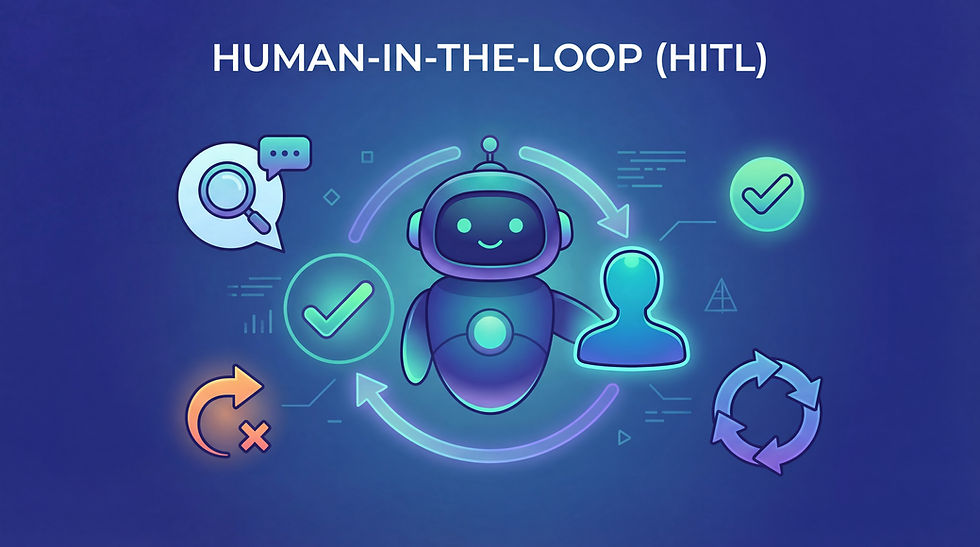
Even with extensive automated testing and evaluation pipelines, production chatbots can't rely solely on machines to guarantee quality. Human-in-the-loop processes are essential for catching edge cases, ambiguous responses, or hallucinations that automated systems might miss.
In serious production environments, HITL is not optional - it is a standard part of the workflow. Alongside automated tests, prompts checks, and evaluation pipelines, mature teams assign a dedicated manual QA layer (testers, analysts, reviewers) responsible for validating critical flows and preventing regressions before they reach real users. In enterprise chatbot products, this function exists on the same level as engineering and observability - not as an afterthought.
HITL can take several forms:
Periodic reviews: random conversation sampling for quality checks.
Targeted reviews: high‑risk flows, new prompts, or updated models.
Escalations: a path for users or support teams to flag problematic responses.
Annotation for training: human feedback that improves prompts, rules, or models.
In production, a well‑designed HITL system ensures that humans are not reviewing every interaction but are strategically involved where automation falls short. Combining human validation with automated metrics and regression tests provides a robust safeguard, helping maintain high‑quality chatbot behaviour even under complex, real‑world conditions.
Load Testing

Load testing is a critical part of quality assurance for chatbot applications, yet it is often missed in LLM-based systems. Unlike traditional APIs, chatbots combine multiple latency-sensitive components: model inference, retrieval pipelines, external tools, memory access, and orchestration logic. Under real traffic, even small inefficiencies in one layer can quickly degrade the overall user experience.
The primary goal of load testing is to understand how the chatbot behaves under realistic and peak workloads. This includes validating response latency at high concurrency, identifying bottlenecks in inference or routing, and verifying that queueing and fallback mechanisms work as expected. Without this testing, systems may appear stable in staging environments but fail under production traffic spikes.
Load testing should focus not only on throughput but also on quality degradation under load. In practice, high traffic often leads to increased fallback usage, timeouts in retrieval, or forced model downgrades. These may keep the system technically available while silently reducing answer quality - a failure mode that is difficult to detect without explicit testing.
A mature load testing strategy includes:
Concurrent conversation simulation with realistic dialogue lengths.
Validation of latency distributions, not just average response time.
Stress testing of queueing and rate-limiting policies.
Observation of quality signals during overload scenarios.
Verification of horizontal scaling for inference and orchestration services.
By regularly running load tests and analyzing both performance and quality signals, teams can ensure that chatbot systems remain responsive and reliable even under extreme conditions.
Customer-Level Testing

In multi-tenant chatbot systems, quality cannot be evaluated only at a global level. Different customers often have different prompts, configurations, knowledge sources, safety rules, and business expectations. As a result, a change that improves quality for one customer may introduce regressions for another.
Customer-level testing ensures that chatbot behaviour is validated separately for each client or tenant. This typically involves maintaining dedicated test datasets, evaluation scenarios, and quality thresholds per customer. These tests are especially important when deploying shared model updates, prompt changes, or configuration modifications across multiple tenants.
Customer-level testing usually includes:
Client-specific prompt regression tests.
Domain-specific conversation scenarios.
Custom safety and compliance checks.
Per-customer quality thresholds and alerts.
This approach allows teams to detect isolated regressions early and avoid situations where a global deployment silently breaks critical flows for a single customer.
Production Monitoring of Quality

Quality in chatbot systems can't be guaranteed solely through pre-release testing and offline evaluation. Even a well-tested chatbot may degrade in production due to changes in traffic patterns, user behaviour, external dependencies, or underlying models. For this reason, continuous production monitoring is a critical component of any quality strategy.
Production quality monitoring focuses on tracking signals that indicate how the chatbot behaves in real-world conditions. Commonly monitored metrics include response latency, error and fallback rates, incomplete or aborted conversations, repeated user questions, and unexpected spikes in tool or retrieval failures. Of course any specific and required metric can be added to the list.
Monitoring is especially important for detecting silent quality degradation. In many cases, the system continues to operate without throwing errors, while response relevance, consistency, or safety gradually worsens. Without explicit monitoring, such issues may only be discovered through user complaints or support escalations, which is already too late.
Effective production monitoring turns quality from a reactive concern into a proactive process, allowing teams to identify issues early, isolate root causes, and maintain a stable user experience as the system evolves.
As you can see, maintaining quality in chatbot applications requires much more than a good model or well-written prompts. It involves a combination of engineering practices, continuous evaluation, monitoring, and human oversight. This does not mean that every system must implement all of these components from day one - quality can and should evolve together with the product.
Thanks for reading this paper, and I hope these insights were useful for your work with chatbot systems. See you soon in the next articles at Data Science Factory!


Comments