
ChatBot Application Guidelines
- Kostiantyn Isaienkov

- Dec 12, 2025
- 12 min read
Updated: Jan 5
Building a modern LLM-powered chatbot application is a complex process that is focused not only on making calls to a model via a user interface. Today, production-ready systems require a robust architecture that includes observability, traceability, configuration management, security controls, and continuous health monitoring. Many teams underestimate these foundational components, focusing solely on prompts or model selection - and as a result, face unpredictable issues, security risks, or degraded performance in production. In this paper, we explore the essential building blocks and action items behind reliable chatbot applications, explain why they are mandatory for any serious product, and highlight the common pitfalls engineers encounter when integrating LLMs into production systems.

Hi there! Today, we are going to focus on the guidelines for building modern chatbot applications. The biggest mistake some developers make is thinking that it is just about connecting a language model without any additional effort. Unfortunately, that is not the case - many behind-the-scenes systems and processes make a bot reliable and safe. We are talking about traceability and alerting, configuration management, monitoring, security checks, and more. So in this paper, we will go through the essential practices and components you need to build a chatbot that actually works in production.
If you just started your journey into chatbots and LLMs in general Large language models usage strategies and How to use OpenAI API in Python can be relevant for you.
Architecture Design

Choosing the architecture is one of the most critical decisions when building a chatbot application because it defines how the system will behave under real production load. The architecture must reflect the actual complexity: while a simple assistant can run inside a lightweight monolith, enterprise-level bots often require a microservices approach to achieve better isolation, parallel development, and independent scaling. Another key factor is future scalability - LLM-driven systems tend to evolve rapidly, so the design should assume that new features, integrations, and increased traffic will appear sooner than expected.
You also need to consider the deployment environment. Cloud platforms provide elasticity and managed services out of the box, while on-premises or hybrid setups require stricter control over data flow, compliance, and latency guarantees. If response time is a major priority, you should carefully design the execution graph of your pipeline - many steps can run in parallel, significantly reducing overall latency.
Since every chatbot processes a substantial amount of data on each request, selecting the right storage layer is also essential. Additionally, you must define how the AI component will operate under the hood - whether it will be an MCP-based agent, a RAG pipeline, or a hybrid solution tailored to your domain.
Finally, there is no universal “golden” architecture. The correct design always depends on your functional requirements, budget, infrastructure constraints, and the experience of your engineering team.
Fault-Tolerant Design

Ideally, this topic belongs to the architecture design section, but it deserves to be highlighted as a standalone component due to its importance. Designing a chatbot to be fault-tolerant is essential for preventing service interruptions and ensuring that user interactions never break due to a single point of failure. LLM-based systems depend on a wide range of internal and external components: model providers, vector databases, storage layers, API gateways, embedding pipelines, and business logic - and instability in any of them can disrupt the entire flow unless the architecture is truly resilient.
To mitigate these risks, every critical component must include a fallback strategy or a graceful degradation path. For example, if the primary LLM provider becomes unavailable, the system should automatically switch to a secondary model. If the retrieval step fails, the chatbot should still produce a coherent response based on conversation context rather than returning an error. Storage layers require similar robustness: caching, replication, and well-designed retry policies reduce the chances of data loss or blocked requests. Queueing mechanisms help control the flow of requests so that services process them at a manageable pace. This prevents slower services from being overloaded when traffic suddenly increases.
Finally, fault tolerance is not only an architectural property, it is also an operational discipline. Regular chaos testing, controlled failure simulations, and continuous validation of fallback logic ensure that the chatbot behaves predictably under stress and recovers without manual intervention. Operational readiness is what ultimately turns a resilient design into a truly reliable production system.
Choosing the LLM
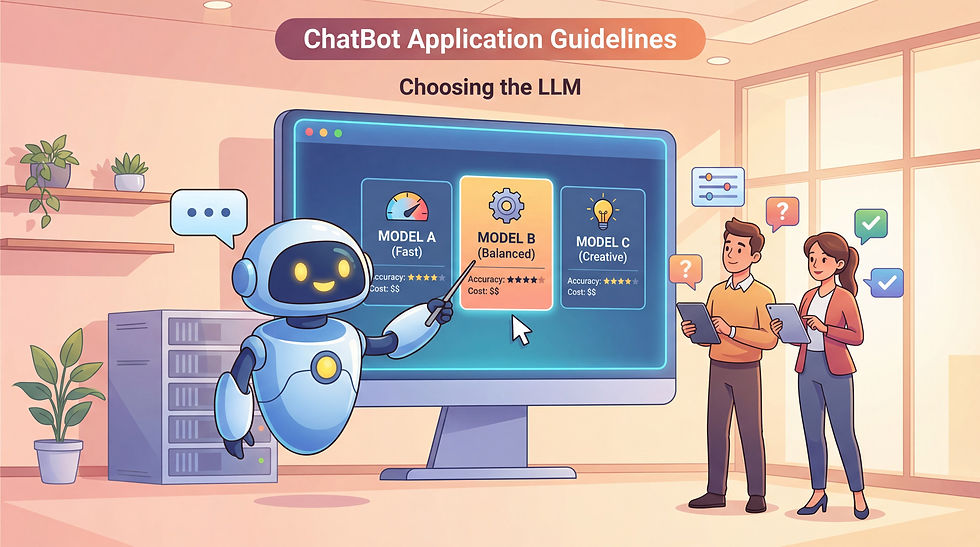
Selecting the right large language model is one of the core architectural decisions that determines how your chatbot behaves, scales, and evolves. The choice depends on multiple factors: task complexity, latency requirements, expected traffic, budget constraints, and the degree of control you need over the model. Some applications require lightweight models for fast inference, while others rely on more capable LLMs for reasoning, tool use, or code generation. You also need to decide whether to use a fully managed API, self-host an open-source model, or combine both in a hybrid setup. At this stage, it is essential to evaluate model accuracy, context length, inference speed, fine-tuning options, and overall cost-efficiency - all of which directly shape the final user experience.
Modern chatbot architectures rarely rely on a single model. Instead, they orchestrate several LLMs or specialized ML components, each optimized for a specific stage of the workflow. For example, a lightweight model can handle intent detection, another can manage classification or safety filtering, while a more powerful LLM is reserved exclusively for generating the final response. In some cases, you may not need an LLM at all for specific tasks: classical Transformer models such as BERT still deliver excellent performance for Named Entity Recognition (NER), semantic classification, and other structured NLP tasks at a fraction of the cost and latency. The choice across the pipeline is always a balance between latency, cost, update frequency, and operational constraints.
Selecting models for each step of the pipeline, follow these principles:
Quality. Use the simplest model that delivers sufficient quality for its specific task. There is no reason to choose a state-of-the-art LLM where a smaller or older model performs equally well.
Response speed. Users expect the chatbot to react quickly. Avoid heavy models in latency-sensitive parts of the pipeline unless necessary.
Cost per request. Prefer affordable models wherever possible. There is no value in paying for a high-end model to perform a task that a cheaper alternative can handle effectively.
Scalability. Managed APIs come with limits on requests per minute (RPM) and tokens per minute (TPM). Ensure that your selected models can support your traffic patterns and scale with the expected load.
Security

Security in chatbot applications is not just a checkbox - it is a continuous process that influences every layer of the system. Since a chatbot frequently interacts with sensitive user data, connects to external APIs, and executes model-driven logic, any weak point becomes a potential attack surface. A production-ready system must follow the OWASP Top 10 principles, enforce strict input validation and sanitization, implement rate limiting, and apply proper authentication and authorization across all internal and external components.
Equally important is addressing LLM-specific security vectors: preventing prompt injection, isolating system prompts, restricting tool and API access, and ensuring that models do not leak confidential information through unintended outputs. Robust logging, monitoring, and audit trails help detect anomalies early and respond to incidents before they escalate.
LLM security also has a direct financial impact. Unlike traditional systems, where attacks typically target data theft or service disruption, an attack on an LLM can result in massive, uncontrolled usage of the model. Prompt injection or forced tool execution can generate thousands of expensive API calls - potentially costing thousands of dollars in minutes. That’s why enforcing strict rate limits, per-user quotas, budget alarms, and usage-based access control is essential for preventing cost-amplification attacks.
Data privacy is a separate and equally critical aspect. A chatbot must handle personal and sensitive data in accordance with applicable privacy regulations (such as GDPR), internal policies, and industry standards. This includes minimizing what data is collected, applying strict retention rules, anonymizing or pseudonymizing records when possible, and ensuring that no private user information is stored or transmitted without a valid purpose. When interacting with third-party model providers, it is crucial to verify how they process, store, or log data, and ensure that protected information never leaves your controlled environment without explicit justification.
Traceability

Traceability is a critical component of any production-grade chatbot application, providing visibility into how each request is processed from start to finish. A robust traceability layer must capture the entire lifecycle of an interaction: the initial user message, preprocessing steps, routing decisions, retrieval operations, LLM calls, post-processing, and the final response returned to the user.
This becomes especially important when multiple LLMs, microservices, or external APIs participate in the pipeline. Traceability allows engineering teams to identify performance bottlenecks, investigate failures, reproduce unexpected behaviors, and validate that the system’s business logic is functioning as intended.
Proper traceability also strengthens auditability and supports compliance requirements by correlating logs, spans, prompts, model versions, configuration states, and system events into a single coherent trace. With this foundation, debugging becomes significantly faster, incident resolution becomes more reliable, and teams can confidently analyze system behavior under real production traffic.
Alerting system
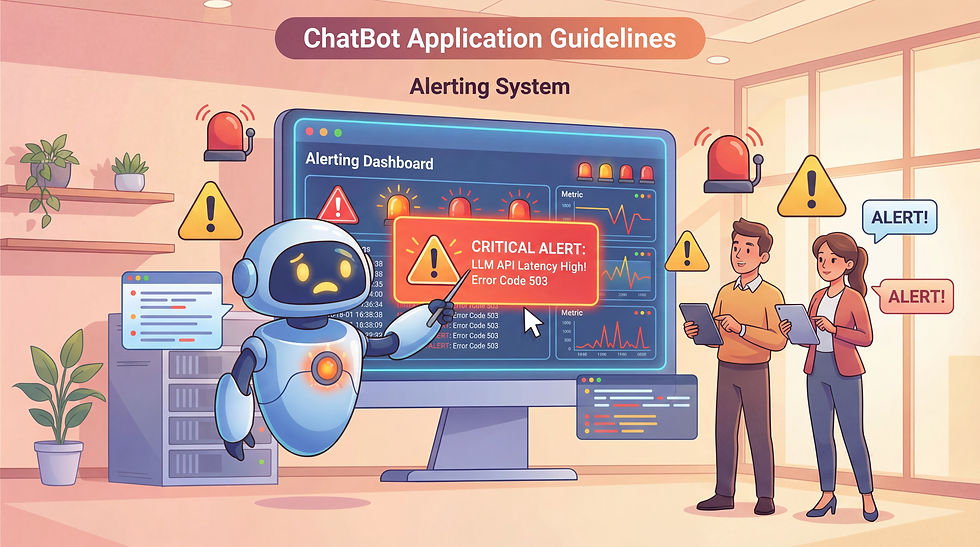
Another critical component of a production-ready chatbot is a reliable, well-designed alerting system. Even with strong observability and traceability in place, you still need real-time notifications when something breaks, slows down, or behaves abnormally. LLM applications are especially sensitive to external dependencies - model providers, vector databases, storage layers, API gateways, which means that silent failures can quickly cascade across the entire pipeline.
A proper alerting setup should detect latency spikes, elevated error rates, degraded model output quality, unusual traffic patterns, configuration mismatches, and failures in background workers or scheduled jobs. The guiding principle is simple: you must know about a problem before your users do. Clear alert routing, escalation policies, and integrations with team messengers like Slack ensure that alerts are actionable, timely, and properly prioritized - not just noise.
Operational readiness also includes continuous, automated health validation. One of the common approaches is a recurring “N-minute viability test”: a scheduled workflow that simulates user interactions every N minutes and verifies that the system can complete a full end-to-end request. This test should cover prompt handling, retrieval, switching between models, calling external APIs, processing business logic, and generating a final response. If any step fails, the system triggers an immediate alert. This technique helps detect subtle issues - model misconfigurations, expired credentials, partial outages, or stuck workers - long before they escalate into user-visible incidents.
Configuration system

A solid configuration system is a core requirement for any production-grade chatbot application. As the number of components grows: models, routing logic, vector stores, external APIs, security keys, rate limits, feature flags - managing configuration manually quickly becomes both unmanageable and unsafe.
A proper configuration layer centralizes all environment-specific parameters, ensures they are versioned, validated, and consistently applied across development, staging, and production. Whether configurations come from environment variables, a dedicated configuration service, or a secret manager, the objective remains the same: guarantee consistency, prevent accidental misconfigurations, and enable safe, controlled changes without redeploying the entire system.
A well-designed configuration system also becomes essential during application scaling. It simplifies multi-region deployments, supports blue-green and canary releases, and enables fine-grained model-level toggles, such as switching between LLM providers, updating model versions, adjusting prompt templates, or enabling new features for a subset of users. With proper configuration management in place, teams can roll out changes progressively, safely, and with rollback control.
Prompt management

Prompt management is a critical component of building a production-grade chatbot. As a system scales, prompts evolve from simple text snippets into structured, versioned artifacts that directly affect model behavior, stability, and accuracy. A mature prompt framework must enforce clear separation between system, developer, and user instructions, support templating, maintain version control, and integrate automated regression testing. These mechanisms reduce the risk of unpredictable LLM behavior and ensure that prompt changes are traceable, reviewable, and reproducible.
A key engineering challenge is customization. Different clients may require unique tone, functional rules, safety constraints, or domain-specific logic. It naturally leads to multiple prompt variants - each with distinct configuration parameters and compliance requirements. A scalable prompt management system must therefore support per-client overrides, prompt inheritance, parameterized templates, and dynamic prompt assembly at runtime. At the same time, it must preserve consistency, enforce safety policies, and guarantee stable behavior across all environments and deployments.
CI/CD

A robust CI/CD pipeline is crucial for maintaining a stable and predictable development process in chatbot applications. Each change, whether it’s code, prompts, configuration, or infrastructure, must pass automated tests, security checks, and validation of integration with all LLM-related components. Because chatbots often rely on multiple services (models, vector DBs, monitoring agents, configuration layers), CI/CD should ensure consistent versioning and compatibility across all of them. It’s also essential to design deployments in a way that eliminates downtime: rolling updates and blue-green deployments help ensure that new versions reach production smoothly without interrupting conversations or breaking active user sessions. A strong pipeline not only accelerates delivery but also minimizes risks when evolving complex LLM-driven systems.
UI/UX

The user interface of a chatbot is often underestimated, yet it directly defines how natural, fast, and predictable the interaction will feel. A well-designed UI should minimize friction: clear input fields, stable message flow, readable typography, and responsive layouts for both desktop and mobile.
UX requirements go further. Users expect immediate feedback that the system is processing a request, consistent handling of errors, and transparent behaviour in cases where the answer is delayed. If the chatbot relies on tools, multimodal inputs, or long-running operations, the interface must clearly reflect these states - for example, showing progress indicators, streaming partial responses, or notifying the user when an operation is still running in the background.
Finally, UI/UX directly affects the perceived intelligence of the system. Even if the underlying models and infrastructure are reliable, a poorly designed interface can make the chatbot appear slow or unreliable. A consistent, predictable, and responsive UI helps ensure that the technical capabilities of the system translate into a stable and satisfying user experience.
Testing

Testing is a fundamental requirement for building a production-ready chatbot. LLM-based applications are inherently nondeterministic: the same prompt may generate different outputs depending on model version, decoding parameters, or the structure of the context window. Because of this, testing must validate not only functional correctness but also behavioural stability, safety, and regression resistance. A consistent testing strategy ensures that new features, prompt updates, or model changes do not break existing flows or introduce unexpected failures.
Key testing components
Unit tests
All deterministic parts of the system must be fully covered. Message parsers, retrieval logic, routing, business rules, configuration loaders, and tool integrations should behave predictably regardless of LLM variability. Standard unit testing keeps the surrounding infrastructure stable even when model outputs fluctuate. To go deeper into unit testing, check Unit testing in Data Science paper.
Prompt regression tests
Each prompt should have a defined set of input/output expectations to detect regressions when:
• the prompt changes,
• the model version changes,
• parameters such as temperature or context window composition change.
This is especially important for multi-tenant systems, where each client may have customized prompt variations.
Integration tests
Integration tests validate the full execution path across the pipeline. They must cover both successful flows and controlled failure scenarios to ensure resilience under real usage conditions.
Load and performance tests
The system must remain responsive under high concurrency. Load tests verify:
• latency at peak traffic,
• queue stability,
• throughput and ability to scale routing or inference services horizontally.
This ensures predictable performance even as usage grows.
User-simulation tests
Simulated multi-turn conversations help identify issues in:
• dialog flow logic,
• long-context behaviour,
• memory consistency,
• fallback and fail-safe execution.
This approximates real-world interaction patterns that unit tests cannot capture.
Manual exploratory testing
Despite automation, LLM systems still benefit from periodic manual review. Exploratory testing helps detect subtle prompt ambiguities, hallucination patterns, UX inconsistencies, and other edge cases that are difficult to formalize in automated suites.
Quality monitoring and improvements

Even after a chatbot is deployed and running in production, the work does not stop. LLM-based systems require continuous quality monitoring to ensure that responses remain accurate, safe, consistent, and aligned with business expectations. This includes tracking model output quality, latency, hallucination rates, user satisfaction, and the stability of conversation flows. It is also important to evaluate how reliably the bot follows instructions, handles edge cases, and reacts to new or previously unseen query types.
Continuous improvement depends on collecting real usage signals - both explicit (ratings, surveys, user feedback) and implicit (drop-offs, escalations, repeated queries, user corrections). Analyzing these signals helps identify degradation, refine prompts, adjust routing and business logic, or update model configurations when needed. Mature systems typically rely on automated evaluation pipelines, regression tests on curated datasets, and periodic human-in-the-loop reviews for sensitive or high-impact scenarios.
The objective is straightforward: the chatbot should not remain static. It should continuously adapt and improve as user behavior, requirements, and model capabilities evolve.
Additional infrastructure

Beyond the core chatbot logic, production-ready systems often require additional infrastructure that improves user experience, operational visibility, and client-level customization. A common example is a history-export API that allows users to retrieve their conversation logs for integration with external systems such as CRMs, analytics platforms, or internal audit pipelines. Another important component is a metrics and analytics dashboard, providing insights into conversation volume, user activity, latency, error rates, and overall system performance.
Depending on product requirements, teams may also implement supporting APIs for managing user profiles, maintaining custom knowledge bases, handling billing data, or exposing real-time event streams for enterprise workflows. While these components are not strictly required for the chatbot to function, they form the surrounding ecosystem that enables better usability, smoother integrations, and higher adoption in enterprise environments.
As you can see, building a modern chatbot application is much more than connecting an LLM to an interface. It requires a solid architecture, proper security practices, a reliable observability stack, configuration and prompt management, CI/CD pipelines, and a clear strategy for continuous quality improvements. But once all these components work together, you get a system that is scalable, maintainable, and truly useful for your users.
Thanks for reading this paper, and I hope this information was helpful to you! See you soon in the following papers at Data Science Factory. If you use additional components or practices in your chatbot applications that were not covered here, it would be interested to read about them in comments.


Comments